
Revision Spine Surgery in Mumbai
Revision Spine Surgery by Dr. Nikhil Arbatti at Advanced Spine Care Clinic, Vile Parle Mumbai.
What Is Revision Spine Surgery?
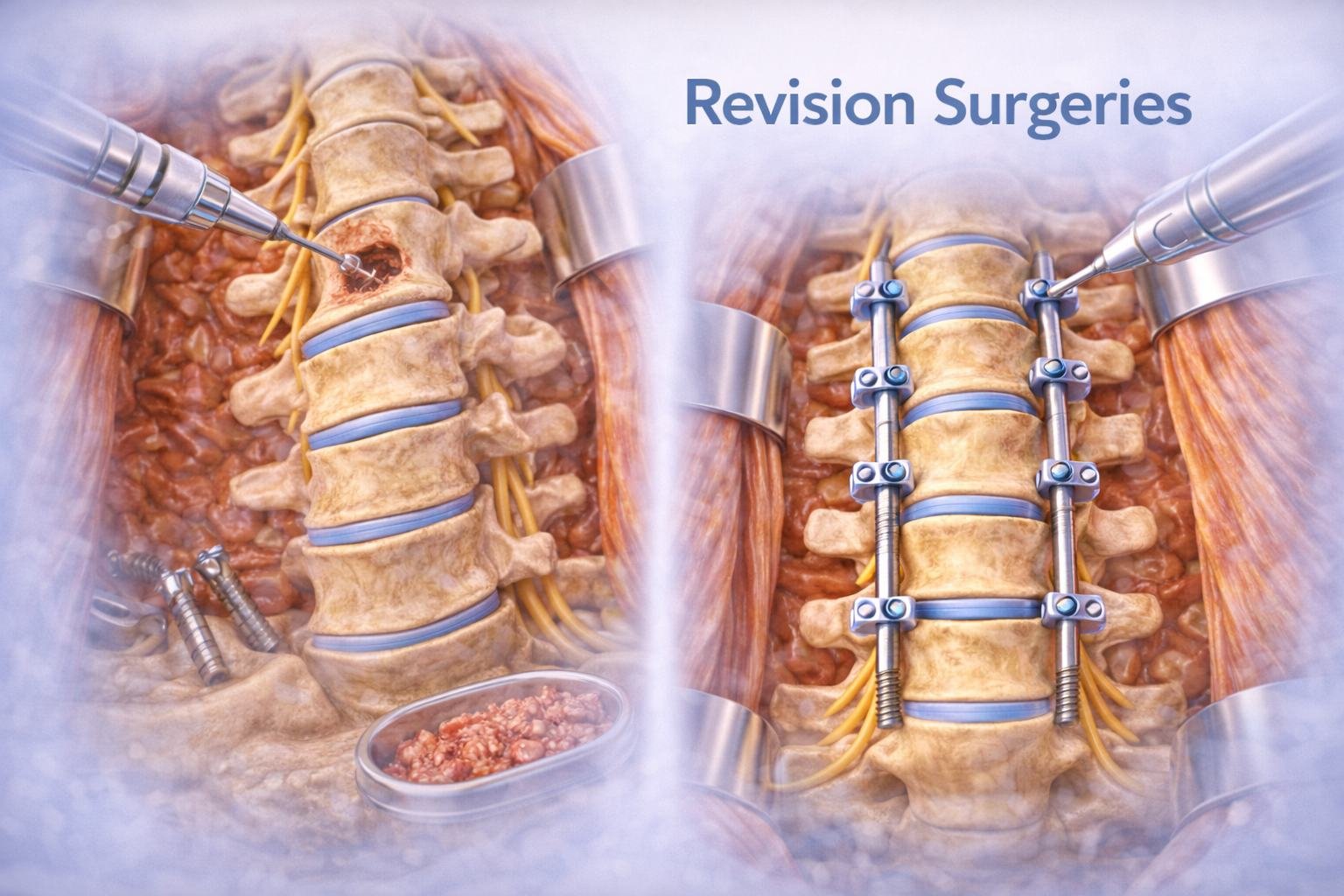
Revision spine surgery is a surgical procedure performed on a part of the spine that has previously undergone surgery. It may be considered when the initial procedure has not adequately addressed the underlying problem, symptoms return after a period of improvement, or a new complication or spinal condition develops.
The reasons for considering revision surgery vary from patient to patient. Some individuals may have recurrent disc herniation or persistent nerve compression, while others may develop spinal instability, problems with surgical implants, failure of spinal fusion, or degeneration of the spinal segments adjacent to a previous fusion.
Unlike an initial spinal procedure, revision surgery requires careful consideration of the previous operation, changes in spinal anatomy, scar tissue, existing implants, and the patient’s current symptoms.
At Advanced Spine Care Clinic, Dr. Nikhil Arbatti evaluates each case individually to determine whether revision surgery is appropriate or whether non-surgical treatment may be a suitable alternative.
When Is Revision Spine Surgery Required?
Revision spine surgery may be considered when a specific, treatable problem is identified after a previous spinal procedure. The decision depends on the patient’s symptoms, clinical examination, imaging findings, medical history, and response to previous treatment.
Common reasons include:
Revision spine surgery may be considered when a specific, treatable problem is identified after a previous spinal procedure. The decision depends on the patient’s symptoms, clinical examination, imaging findings, medical history, and response to previous treatment.
Common reasons include:
-
1
Recurrent Disc Herniation: A disc may herniate again after a previous discectomy, causing renewed pressure on nearby nerves. This can result in back or neck pain, pain radiating into the arms or legs, tingling, numbness, or weakness. -
2
Persistent Nerve Compression: In some cases, the original surgery may not have completely relieved pressure on a nerve. Residual disc material or spinal canal narrowing may continue to cause symptoms and may require further assessment. -
3
Failed Spinal Fusion: Spinal fusion aims to unite two or more vertebrae into a stable segment. If the bones do not fuse adequately, a condition known as non-union or pseudarthrosis may develop. Selected patients with associated pain or instability may require revision treatment. -
4
Implant or Hardware Complications: Screws, rods, plates, cages, or other implants used during spine surgery may loosen, break, shift, or become associated with other complications. Revision surgery may be considered when these issues cause symptoms or compromise spinal stability. -
5
Adjacent Segment Disease: Following spinal fusion, the spinal segments above or below the fused area may develop degeneration over time. If this causes significant nerve compression, instability, or other symptoms, further treatment may be necessary. -
6
Postoperative Spinal Instability: Some patients develop or continue to experience abnormal movement between spinal segments after surgery. If instability is confirmed and correlates with symptoms, revision stabilisation may be considered. -
7
Spinal Deformity or Alignment Problems: Changes in spinal alignment or progression of an existing deformity may sometimes require corrective surgery, depending on the severity, symptoms, and overall spinal condition.
Important: Persistent pain after spine surgery does not automatically mean that another operation is necessary. The underlying cause must be identified before revision surgery is recommended.
How Is Revision Spine Surgery Performed?
The revision spine surgery technique depends on the original procedure, the affected spinal region, the current diagnosis, and the specific problem that needs to be corrected.
-
Step 1: Detailed Evaluation The surgeon reviews the patient's medical history, previous surgery details, current symptoms, physical examination findings, and available investigations.
-
Step 2: Review of Previous Surgery and Imaging Previous MRI scans, CT scans, X-rays, operative notes, and implant details can help clarify the original condition and identify changes since surgery. Additional investigations may be advised when required.
-
Step 3: Identification of the Underlying Problem The goal is to establish whether symptoms are caused by recurrent disc herniation, persistent nerve compression, non-union, hardware complications, instability, adjacent segment disease, or another condition.
-
Step 4: Individualised Treatment Planning Depending on the findings, treatment may involve medication, physiotherapy, pain management, observation, or revision surgery. When surgery is appropriate, the procedure is planned according to the patient's specific needs.
-
Step 5: Revision Procedure Depending on the diagnosis, surgery may involve removing recurrent disc material, decompressing compressed nerves, revising or replacing implants, addressing a failed fusion, or restoring spinal stability and alignment. The approach may be open or minimally invasive, depending on the anatomy, previous procedure, and surgical requirements.
-
Step 6: Postoperative Care and Rehabilitation After surgery, the patient receives an individualised recovery plan that may include pain management, appropriate mobilisation, wound care, follow-up assessments, and physiotherapy when advised.
Benefits of Revision Spine Surgery
When a correctable problem has been identified and surgery is appropriate, revision spine surgery may help to:
-
Relieve pressure on compressed spinal nerves.
-
Address recurrent disc herniation or residual spinal canal narrowing.
-
Improve spinal stability in selected patients.
-
Correct complications associated with previous spinal implants.
-
Treat selected cases of failed spinal fusion.
-
Address symptomatic adjacent segment disease.
-
Improve mobility and daily functioning when the underlying condition responds to treatment.
The benefits depend on the cause of symptoms, the patient’s overall health, the extent of previous surgery, and the procedure performed. Complete pain relief cannot be guaranteed.
enquire Now
Consult the Best Spine Surgeon in Mumbai
If you are struggling with back pain, don’t delay treatment. At Advanced Spine Care Clinic, Vile Parle West, Mumbai,
Spine Conditions
- New Page 1
First Sub Title
- New Page 2
Second Sub Title
- New Page 3
Third Sub Title
Why Choose Dr. Nikhil Arbatti for Revision Spine Surgery in Mumbai?

20+ years of spine care experience

20,000+ patients consulted & 5,000+ successful spine procedures

Gold Medalist Orthopaedic Surgeon, Fellowship-trained in Spine Surgery

Expertise in Minimally Invasive & Endoscopic Spine Surgery

Personalized patient care with a dedicated team of spine specialists
Find Out Answers Here
Revision spine surgery is an additional operation performed on a previously operated part of the spine to address a specific problem, such as recurrent disc herniation, persistent nerve compression, failed fusion, implant complications, or spinal instability.
Revision surgery may be considered if symptoms persist, return after initial improvement, or develop due to a new spinal condition or complication. A specialist must evaluate the cause before recommending another procedure.
No. Persistent pain can have several causes, including muscle-related pain, nerve irritation, recurrent disc problems, adjacent segment degeneration, or conditions unrelated to the operated area. Further assessment is needed to determine the cause.
Minimally invasive techniques may be suitable for selected revision procedures. However, they are not appropriate for every case. The surgeon determines the safest and most effective approach after reviewing the patient’s condition and previous surgery.
Bring previous MRI, CT and X-ray reports or images, the operative notes if available, discharge summaries, implant details, current prescriptions, and any recent investigation reports. These records can help the surgeon understand your previous treatment and current condition.
No. Depending on the diagnosis, treatment may include medication, physiotherapy, pain management, or observation. Revision surgery is considered when a specific problem is identified and the expected benefits justify the risks.
You can contact Advanced Spine Care Clinic, located in Vile Parle West, Mumbai, to arrange a consultation with Dr. Nikhil Arbatti and discuss your symptoms, previous spinal procedure, and available treatment options.

Consult Dr. Nikhil Arbatti for Revision Spine Surgery in Mumbai
Persistent or recurring symptoms after spine surgery can be challenging, but understanding the underlying cause is an important first step towards appropriate treatment.
At Advanced Spine Care Clinic, Vile Parle West, Mumbai, Dr. Nikhil Arbatti provides specialist evaluation for patients experiencing ongoing or recurrent spinal symptoms after previous surgery. A detailed review of your medical history, previous procedure, and current investigations can help determine whether further treatment, including revision spine surgery, may be appropriate.
Discuss your symptoms and previous surgical history with a spine specialist to understand your treatment options.